Showing posts with label moths. Show all posts

Sunday, July 19, 2026

Some Upcoming Events in Wichita Falls


There are two events coming up in the next week that should be of interest to followers of this blog.


July 23, 6 PM, The Forum, 2120 Speedway Ave. Monthly Wichita River Native Plant Society meeting. 

Monarch Waystations for Texas

Covers the amazing story of the Monarch Butterfly life cycle and migration, clarifies some common misconceptions about Monarchs, explains historic and current trends to Monarch populations, and why Texas is critical for Monarchs' future success. The program also covers real steps Texas residents can take to help bolster the Monarch populations, and how to create a Monarch Waystation using native plants.

Or speaker: Carol Clark is a Texas Master Naturalist, long-time member of the Native Plant Society of Texas, former Chair of the Bring Back the Monarchs to Texas committee of NPSOT, and a Monarch Watch Conservation Specialist. When she isn't busy teaching others about pollinators and native plants, she enjoys looking after her own colossal Monarch Waystation and wildlife refuge in Cooke County.

This meeting is open to the public and free to attend.

July 25, 7:00 - 9:30 PM, Wichita Falls Museum of Art at MSU, Mothing and Art.

The Museum is hosting a Framing Nature: Animals through Art exhibition through December 19. In conjunction with this exhibition, the Museum will be open for a late-night event co-sponsored by the Rolling Plains Chapter Texas Master Naturalist. Members of the chapter will lead a stroll along the path around Sikes Lake just before sundown to look for moths. Once the sun goes down, they will be using black lights to attract moths, and other insects, for a closer look. Water and restrooms will be available in the museum. The museum will also be open for the public to view the exhibit. DO NOT WEAR bug spray since it is toxic to the moths.

Saturday, July 26, 2025

Moth Week

Vine Sphinx moth
 

 I almost let the week go by without recognizing Moth Week. Moths don't get the press that butterflies do, probably because they aren't as active during the day and many of them are fairly nondescript. Obviously, that's not the case with the vine sphinx moth the to left. I did find this one during the day, so the colors are easy to see.

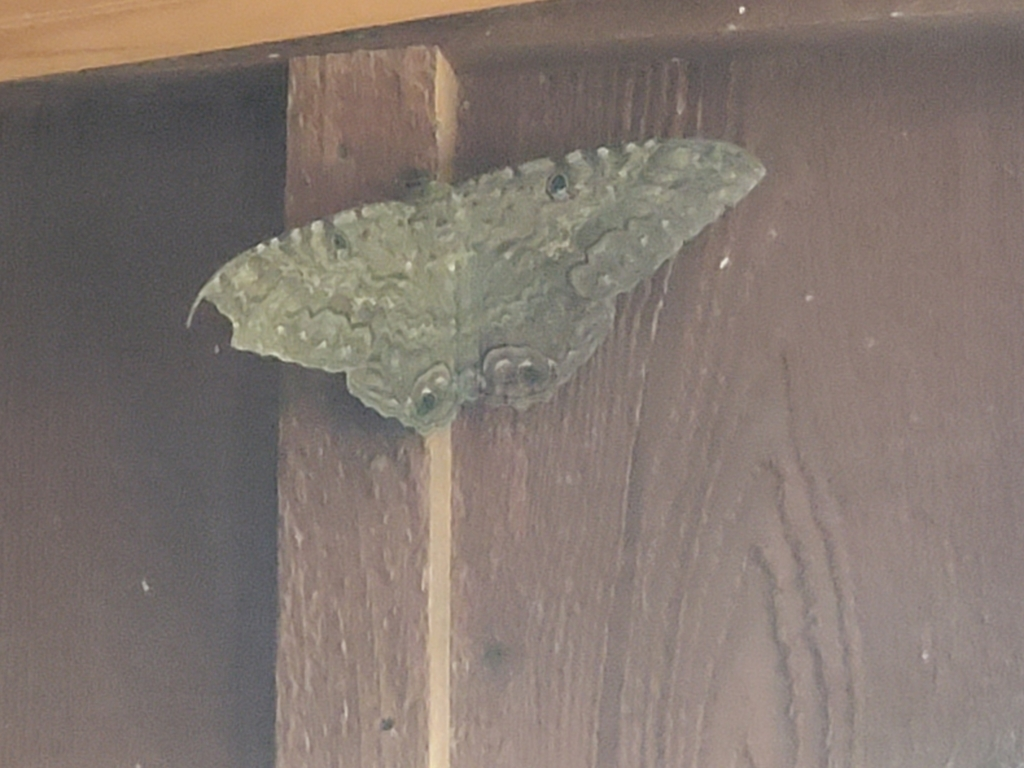
Black Witch moth
The black witch moth on the right is a migrant. I took this picture at night, so the markings aren't as clear, but it is also a dark moth. It is a lot larger than it appears in this photo. Think just a little smaller than my hand.

Moths are important pollinators. Moths prefer light-colored, fragrant, and long tubular flowers, especially those that open at night. Some examples are honeysuckle, morning glory, bee balm, milkweed, columbine, asters, clovers, phlox, thistles, yucca, and vetches. Some food plant pollinated by moths as well as bees include redcurrants, strawberries, and stone fruit. 

Moths are a prime food source for bats.

Most people know that the monarch butterfly migrates, but many other butterflies and moths do as well. I mentioned the witch moth above migrates through here, but so do other moths. Not a lot is known about moth migration, but here is a short piece on the subject. Although the study was done on moths in Europe, the information is applicable here.

I hope you'll take some time to learn more about these fascinating insects.

Saturday, June 23, 2018

Here's to Our Pollinators!


I know, I should have written this post at the beginning of the week, instead of the end, but....I am doing it now. Pollinators are just too important not to make a big deal about them.

On the hunt for pollinators

Beetles are great pollinators!
I celebrated Pollinator Week today by going out to Lake Arrowhead State Park and looking for pollinators with a few of the Texas Master Naturalists. We had some kids along as well, so we had a really good time.

Most people think bees are the only pollinators and they are important, but other bugs like flies, butterflies, moths, wasps, and beetles are also important pollinators. So are hummingbirds and bats. In specific instances, birds and even lemurs pollinate certain species.

I garden, as do many of you. Have you noticed fewer bugs in your garden? I certainly have. I also haven't seen many in my flower beds and I plant to attracts wildlife. I don't use pesticides or chemical fertilizers, although I think I am the only person in our neighborhood who doesn't. But back to the lack of bugs (well, except mosquitoes, which seems to be the only bug in the yard). This is not a good thing. If we like to eat, we need pollinators. More than 1/3 of all of our food has to be pollinated by some living thing.

So what is happening with pollinators and what can we do?

I have yet to figure out why people feel like they have to kill every living thing that they see as "icky." Bugs, spiders, and snakes, for example. Every year here in the Falls people go crazy because of rattlesnakes and kill every snake they see. But many of the pictures of dead snakes posted proudly in Facebook are not rattlesnakes at all--they are rat snakes or some other harmless snake. But at least for snakes, they are using blunt force trauma for the most part--not good for the snake, but the damage is reasonably contained to the snake.

However, then we have a rodent problem, so then we drag out the rodent poison. Not only is poison a horrible way to die, but these poisoned rats and mice are now eaten by other animals who were not the intended target, but who are now also poisoned. That might be your pet cat or it could be a hawk or an owl. Poisoned rodents are often taken by birds of prey, which also then die. So, first, let's not spray our yards with insecticides. If you have a significant problem and cannot find a nontoxic solution (and there are many out there) then use the least amount of poison possible. Home application of insecticides is much higher than agricultural applications. Many homeowners are like Tim the Toolman--if a little is good, then a lot must be a lot better. But that is not the case. The rest runs off into our water supply or blows into your neighbor's yard.

Next, lawns are a waste. There is nothing little for pollinators to use as food. Plant some native plants that appeal to pollinators. Not a single plant, but groups of them. Plant different kinds of plants to attract different types of pollinators and which will bloom at different times of the year, to provide food all year long. Besides, once these plants get started, you'll have less work mowing and putting down fertilizer and more poisons--costing you money and harming your environment.

Messy yards are not a crisis. If you want, make the front yard pristine (although I don't advocate that), but have some messy places, with leaves and brush, where pollinators and other small wildlife can live and be safe.)

I know here in north Texas it is almost a religion that climate change is a hoax. No, the hoax is that a small group of nutcases have managed to convince large numbers of people that science is wrong. There are only a couple of fringe scientists who are not certain that climate change is real and that people are the primary cause. Climate change is causing or contributing to a host of environmental issues--one of which is pollinator collapse. Make purchasing decisions based upon the product's impact on the environment. You may rightfully say that your single purchase makes no difference, but all of our purchases can make a huge impact. So stop using that as an excuse. Elect people who respect and understand science and who do not pander to a very loud minority. If you cannot understand the science and the long-term effects of government policies on the future my grandchildren will be living in, I don't want you in a position to make those decisions.

So, to summarize:

  • Stop poisoning your home and yard
  • Plant lots of native plants
  • Let there be some messy spots
  • Advocate for the environment
  • Elect people who understand the policy implications of science and act accordingly
Let's support our pollinators in Wichita Falls.




Tuesday, September 23, 2014

Pollinator Workshop

Penny speaking at the Pollinator Workshop at
River Bend Nature Center
We had a pretty good group for the Pollinator Workshop at River Bend Nature Center tonight.

We even had a couple of young people. One was working on an entomology project for Camp Fire. His proud mom told me he had won a prize in River Bend's photography competition for his photo of a parasitid wasp larvae in a caterpillar.  How cool is that?

Just a summary of a few of the main points of what we can do to help the pollinators.  I realize some of the points may not be clear without the background information in the presentation. All I can say it, "You should have been there!" Seriously...if you have questions, feel free to contact me off line at green.wichitafalls@gmail.com.

As individuals, we can:

  • Plant a pollinator friendly yard
    • Plant natives
    • Put in plants pollinators like
    • Plant varied types of flowers with varying flowering periods
    • Accept some losses
  • Provide nesting areas
  • Don't use (or use sparingly) poisons in your yard
  • Buy organic when possible
  • Use Save the Night practices
  • Advocate
As a citizen, we can help our community be more pollinator friendly by:
  • Being a smart consumer (money talks)
  • Encourage native plants at our workplaces and community areas (medians, for example)
  • Educate
  • Advocate

Good questions and discussion following.